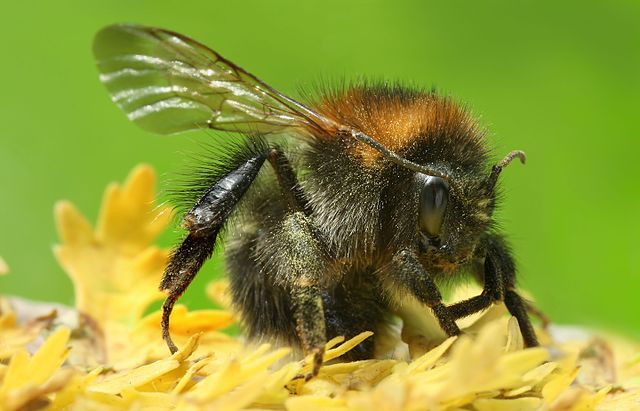
Dave Goulson is a professor at Sussex University who specialises in bumblebees. Here, he talks about why our pollinators are disappearing, and what we can do to stop it.
Jason Kingsley 0:01
It seems like we get bad news about the planet every day. But one sign I’m particularly concerned about and is particularly worrying is the disappearance of insects and specifically our bees. Today I’m speaking to David Golson from University of Sussex about how bad the situation really is, what we could do to help and what it means for humanity if we don’t. Welcome to Future Imperfect. Hi, everybody, welcome to Future Imperfect. I have with me a professor of biology from Sussex University. Dave Goulson, Dave, you have a fascinating speciality and some really interesting books that we’re going to talk about. So do you want to take it from there?
Dave Goulson 0:45
Yeah, sure. As you said, I’m a professor of biology at Sussex University. I’ve been there for about eight years. So my speciality is insects, particularly bumble bees. I’ve been studying bumble bees for nearly 30 years now. I’ve been obsessed by insects since I was a kid, I have no idea why. Different people are drawn to different things. For me, I just loved that. I remember collecting caterpillars from the edge of the school playground when I was only about five or six years old and sticking them in my lunchbox and taking them home and rearing them up. They eventually turned into these beautiful moths. And I just thought that was really cool. Somehow I’ve been lucky enough to make a career from chasing around after insects.
Jason Kingsley 1:26
Wonderful. Is your interest in bumblebees, professional focus, is this an area that needs study? And that is particularly important to us? Because obviously, pollinators are vastly important for life on the planet in terms of plants and stuff. So, do you want to explain their perspective in life and how it sort of fits in with that great network we call nature.
Dave Goulson 1:48
Yeah, happy to. The reason I started studying bumblebees was not because they’re economically or ecologically important. It was just I spotted something interesting. There’s a little nature reserve on the edge of Southampton called the Itchen Valley Country Park. And I was idly watching a patch of comfrey and these bumble bees that were flying around, and I noticed that the bees often fly up to a flower with their antennae kind of out and at the last minute they veer away without touching the flowers as if there’s something wrong with it. Anyone can see this. Once you’ve seen it you suddenly realise it’s actually it’s really common. Bees do it continually in every patch of flowers you look at and I thought, Well, what are they doing? They seem to be being fussy, but why are they avoiding certain flowers? I ended up spending five years trying to work out what was happening with a PhD student called Jane Stout. To cut a five-years story short, basically they’re sniffing the flowers. What they’re sniffing them for is the faint whiff of the footprint of the previous bee having recently landed on the flower because if one’s recently visited it, it’ll be empty, there’ll be little or no pollen or nectar left. So it’s a cue that helps them save a little tiny bit of time that otherwise they would spend climbing into an empty flower. I just thought that was quite clever. And actually I mean bumblebees are the sort of the the intellectual giants of the insect world, they’re really smart, relatively speaking,
Jason Kingsley 3:11
Bumblebees, for those that don’t necessarily know, tend to be bigger than honeybees. Most people are familiar with honeybees. And they’re more communal, aren’t they? And am I right? Bumblebees, can be solitary or can have little groups social groups?
Dave Goulson 3:25
Yeah. Actually, the majority of these are solitary creatures, which is something most people don’t appreciate. So in the UK, we’ve got about 270 species of bee and about 240 of those are solitary creatures where a female just makes her own nest. There’s no workers, there’s no queen. And then at the other end of the spectrum are honeybees which live in vast colonies of tens of thousands of workers or daughters looking after the queen. And bumblebees are kind of between the two they have small colonies that are short lived. They only live for four or five months at best, but they do have workers and the queen who does most of the reproduction and as you say they are the big furry, often colourful insects that we commonly see in our gardens. Bumblebees are the most obvious bees. And if you’d ask someone to draw a bee they’ll draw something that’s big and fat with yellow and black stripes. And they’re basically they’re drawing a bumblebee.
Jason Kingsley 4:20
That’s wonderful. So they have a sort of a gentle reputation. Do they sting at all? Can they be aggressive?
Dave Goulson 4:26
Yeah, they certainly do sting. I’ve been stung quite a few times over the years, but I’ve deserved it. When they’re on flowers, they’ll never sting you unless you grab them in your hand or sit on one or something. They are basically pretty docile. The only time they will deliberately sting you is if you open up their nest, they’ll sting to defend the nest, the queen and so on. And some species are a bit stroppier than others, they will sometimes actually chase you. I’ve had to run away a few times when I’ve been dealing with bumblebee nests, but but otherwise they’re very peaceful.
Jason Kingsley 5:01
That’s interesting. I mean, presumably bumblebees have been around, the history of them goes back way before humans are around. How far back does it go? And what’s the evolutionary history of it? Obviously, it seems like honeybees and the hives are quite unusual when it comes to the bee type of creature. It would be interesting to delve into a little bit about why you think that might have happened that way. But when were bumblebees or types of bumblebees first on the planet, roughly?
Dave Goulson 5:29
So actually, it probably makes sense to go back to the beginning of bees. So bees evolved from solitary wasps, about 120 million years ago. So that was back when dinosaurs were wandering around. And so the first bees would themselves have been solitary. So their wasp ancestors probably stocked a nest with paralysed insect prey and laid their eggs on them. At some point, one of those species of wasps switched to stocking the nest with pollen instead of insects as a sort of alternative protein source. And that was basically the sort of first bee, so, if you like, bees are sort of wasps turned vegetarian. And they evolved sociality after that, but still probably 100 million years or more ago. In fact, the oldest fossil bee we have trapped in amber is from about 100 or so million years ago, and that this is almost identical to a social stingless bee that’s alive today. So they evolved the social lifestyle pretty early on. Bumblebees are actually relative newcomers. And they appeared about 30 million years ago. So still, obviously, way, way, way before we were around. But after the dinosaurs had gone, and in the sort of age of giant mammals, and there was a cold period in Earth’s history, which may explain why bumblebees appeared around then, because they’re basically big, furry creatures that are adapted to living in cold, wet, windy climates like ours. So in that respect, they’re quite unusual. Most insects are at their most numerous and species rich in the tropics, but actually very few bumblebees live in the tropics. They’re more of a temperate creature.
Jason Kingsley 7:07
So, would there have been bumblebees hovering around woolly mammoths and woolly rhinoceros? Is that too cold for them?
Dave Goulson 7:15
No, there certainly would have been. So today there are bumblebee species that live in the Arctic Circle. There’s bombas polaris, and several others that lived their whole life cycle in the really short Arctic summer. And the reason they can do that is they’re very weird and unusual insects, they generate their own heat. You know, most insects are cold blooded, essentially, their body temperature is more or less the same as the air temperature. And they have to sit in the sun if they want to warm up, but bumble bees, and a few other large insects like Hawk moths, and some big dragon flies and so on, generate heat in their flight muscles. And in the case of bumblebees, the fur keeps it in. And so they can fly around when the air temperature might be below zero.
Jason Kingsley 7:56
That’s really interesting. So this is sort of very broadly parallel to mammals sort of developing the ability to sort of have warm blood and expand the environments they live in.
Dave Goulson 8:07
Yeah, they’re kind of more similar to us than they are to many other insects, at least in respect to how they maintain their body temperature.
Jason Kingsley 8:13
I just love the idea that there’ll be bumblebees hovering around woolly mammoths. It’s a really cool image. So obviously, that’s the past. Now, it appears that there are some issues at the moment with declining insect numbers in the modern world caused by a whole bunch of interrelated issues, I would imagine. Do you want to just expand upon that, because it’s obviously a huge concern for us?
Dave Goulson 8:36
There’s a growing body of evidence that showing that insects broadly appear to be in decline. Most of the long term data we have is from Europe and North America. So there’s some massive knowledge gaps. And even in Europe, which is the sort of best studied place in the world, there are lots of insects that nobody’s bothering to count at all the more obscure ones. But the datasets we do have, which mainly are for things like butterflies and moths, and bees suggest that they’re in decline. Some of the datasets show really rapid decline, which is pretty alarming. There was a study published mainly by a bunch of German entomologists in 2017, I was one of the authors, it must be said, but I did very little to deserve that, that it was based on this really big data set collected mainly by amateur insect enthusiasts all over Germany, who put out these traps that catch flying insects called malaise traps, and they found a 76% decline in the biomass of flying insects in 27 years up to 2016. That really kind of set alarm bells off around the world, I think, because people will think well, is this something really strange happening in Germany? Or is this happening everywhere? And if it is happening everywhere, you know, there’s going to be consequences if this carries on. All the data we have suggests that it is a general pattern, maybe the German data, the rate of decline seems to be a bit faster than that of other insects, but nonetheless, there is a problem. And obviously, there are lots of repercussions because insects are really important. I mean, they make up the bulk of life on Earth in terms of numbers of species. We’ve so far named about one and a half million species in total animals and plants and everything else put together, of which 1.1 million are insects. So if they disappeared, that’s most of biodiversity gone. But then, of course, an awful lot of things eat insects, so many birds and bats and lizards and freshwater fish eat insects, so they’ll go because they’re going to need to eat. Insects do a whole bunch of other things. Often they’re just called ecosystem services (a phrase I never find terribly helpful) but anyway, things like pollination is the one that people recognise, but there are a whole bunch of others like pest control and recycling of dung and dead bodies, and leaves and trees and all sorts of other things keeping the soil healthy, and so on, and so on. So basically, we do need insects.
Jason Kingsley 10:59
And also it’s not just the adult form, which is crucially important is it a lot of them have larval stages, which exist in the earth, from what I remember, they’re everywhere on land.
Dave Goulson 11:09
And in freshwater, basically, there are so many insects that they’ve evolved to occupy almost any imaginable niche you can think of any place you don’t get them is in the sea. Interestingly, virtually no insects in the sea. But basically, the crustaceans are the sort of marine equivalent of insects, really, they’re a kind of sister group of arthropods.
Jason Kingsley 11:28
And they’ve been there an awfully long time. So they probably aren’t very easy to muscle out of that niche.
Dave Goulson 11:39
The keys to insects’ success, really on land is being able to fly and being waterproof. neither of which is any good to you in the sea. And as you say, crustaceans have a several hundred million year headstart on them in the sea. So yes, I think that explains why there, they never made it a success there.
Jason Kingsley 11:57
Whoa, okay. Right. So the human food chain is obviously dependent, to a large extent, on insects in all sorts of different ways. I mean, obviously, insects are a challenge to the human food change sometimes as well, in terms of pests. And obviously, pesticides. You know, there’s a lot of money spent on pest control and pests, I guess, are a human definition of an annoying insect that’s going to consume what we don’t want them to consume. I remember the story of DDT back in the day being banned a long time ago, because it causes problems further up the food chain, that trophic pyramid, but that might be worth talking about a little bit and how that reflects on what’s happening with neonicotinoids as well.
Dave Goulson 12:46
Yeah, it’s a murky and slightly sordid subject, I must admit. It’s something I got drawn into and have done quite a bit of research on. So let’s start at the beginning. Basically, synthetic pesticides really emerged around the Second World War, there were two kind of groups: DDT and its relatives, which was developed for controlling mosquitoes and preventing malaria in the troops fighting in warmer climates. And at the same time, in Germany, they were trying to develop nerve agents to kill people, and they invented organophosphate insecticides. Anyway, they were introduced, and they became enormously popular with farmers the following the Second World War, it seemed like they were kind of wonder-product that could greatly increase crop yields. Everyone was with hindsight, somewhat naive. Of course, it didn’t go well. It quickly turned out that there were side effects of using these products. They weren’t just killing the insects we wanted to kill, they were killing everything else. The pests were becoming resistant, so farmers were applying more and more and getting poisoned themselves. And as you mentioned, DDT in particular, bio-accumulates in the food chain. So top predators, like birds of prey were starting to die and their egg shells were thinning, so they broke before they could hatch. And there was a whole catalogue of disasters, which were really kind of brought to the world’s attention in 1962, when Rachel Carson published Silent Spring, an iconic book, which described all the harmful environmental damage being caused by pesticides. There was quite a backlash and a big, heated debate that went on for a while. Eventually, most of those early pesticides were banned. I think it’s fair to say that scientists at that point slightly took their eye off the ball. We kind of thought the problem had been solved in there, we were all taught about how DDT had caused all these problems, but now they’ve been got rid of and replaced with much safer chemicals, or at least so we thought, and it was only really in the 1990s that attention began to return to pesticides, when this new family of chemicals called neonicotinoids started to be flagged up as causing kind of similar problems in a way to DDDT and its relatives. So neonicotinoids are neurotoxins. They’re basically synthetic variants of nicotine. They’re incredibly poisonous to insects. I mean, weight for weight, they’re 7000 times more poisonous than DDT is to insects. A few nanograms is all it takes to kill a honeybee, for example. And they were introduced in the mid ’90s. Just as with DDT, they were terribly popular to start with, as no one foresaw side effects. But it turned out that they’re actually rather persistent in the environment, they accumulate in soils, they were turning up in pollen and nectar of wild flowers, contaminating rivers and streams basically getting everywhere. I mean, this is kind of like novichok for bees, incredibly poisonous neurotoxins. Eventually it became clear that they were one of the reasons why the bees were declining, and probably one of the drivers of insect declines more generally. And the European Union when enough evidence accumulated, banned most of them in 2018. But they’re still very widely used in the rest of the world. And I guess the bigger picture is that we now have hundreds of times more pesticides available to farmers that in Rachel Carson’s day. This seems to be a general pattern of them slipping through the regulatory process, then after decades of use evidence starting to appear that they’re doing harm. And it’s not just neonicotinoids, there are dozens of other pesticides that over the years have been flagged up as harmful and usually eventually removed from the system. But all the time, they’re replaced by another one and another one that we just go round and round in circles. And the fundamental problem doesn’t go away. I think essentially, if you know, we currently apply 3 million tonnes of pesticides to the world every year. If you do that there are going to be side effects, there are going to be undesired consequences, you’re going to kill things you didn’t mean to kill.
Jason Kingsley 16:56
Do you think there should be a different regime for introducing agricultural chemicals? In that there’s a presumed toxicity and you have to prove otherwise? I suppose if it all came down to money, you’d have to prove that it’s not so toxic, or prove that it can be used safely. I think the US has a policy, which is everything is okay unless it’s proven not to be whereas other regimes have it the other way around. With drugs, you have to prove that it’s safe or you prove its effectiveness. I wonder whether it’s the way round, you know that the agri-businesses can introduce a thing, do a quick survey, decid it kills the thing they’re spraying, sell it, and then suddenly, the evidence accumulates over the years that it’s actually bad, then by then the damage is done. And I wonder whether it needs a different approach in regulation?
Dave Goulson 17:49
Yeah, it does, certainly. But as you can guess, there’s huge resistance to any change that would make it harder to register new chemicals. And they are tested for harmful effects on beneficial organisms like bees. But the tests are quite superficial. So they tend to be short term studies where you expose, let’s say, a honeybee to a single dose of pesticide. And if it’s still alive after 48 hours, then all is deemed to be fine. Right? Well, the simplistic way in the real world was a more likely scenario is that bee might be chronically exposed for weeks or months, probably not to one pesticide, but to a mixture of pesticides. And those kinds of aspects aren’t looked at at all, in the regulatory process. So it misses things. It doesn’t look at sub lethal effects, which in the case of neonicotinoids, it turns out, aside from being lethal in very small doses, in even smaller doses, they impair the learning ability of bees, so they can’t navigate. That’s as good as a death sentence to a bee. But in a lab test tube, you wouldn’t see any harm at all. So there are lots of things like that that basically aren’t evaluated, and which is why we end up with this situation where chemicals that are harmful slip through the net over and over again. How you come up with a better system – the medicine system seems to be slightly better, in that it requires a demonstration that any new drug is not only is it safe, but also that it has to be better than any existing drug that’s on the market, which would probably help the or at least reduce the kind of proliferation of pesticides.
Jason Kingsley 19:29
But there must also be an educational component to this as well so that the farming community needs to learn to minimise the use of these things. I understand that we’ve got to grow food for an ever-expanding population and chemicals play a part in that so do fertilisers but there are aspects of it that we need to think about medium- and long-term as well. How is the education of the farming community to this issue going?
Dave Goulson 19:53
There is a bigger picture that is worth thinking about, which is the whole industrial farming model. It’s flawed. It isn’t just that it’s wiping out these pollinators, it’s one of the biggest drivers of biodiversity loss globally, but it’s also doing terrible damage to soils. It’s a massive contributor to climate change, roughly a quarter of all greenhouse gas emissions are associated with farming, so it can’t carry on the way it has gone. We need to somehow come up with a way of feeding everybody that’s sustainable. It has to be sustainable, because we want to carry on doing it into the future. And at the moment, the system we have is not sustainable, it’s doing too much environmental harm. So we should be looking for alternatives. It sounds a bit hippie, but basically, I think we need to try and work with nature rather than against it. We need to be encouraging natural enemies of crop pests rather than spraying insecticides that kill the natural enemies; we need to be encouraging pollinators; we need to be looking at the soil and soil health and carbon capture in soil and so on, and so on, which the current regime isn’t really doing. I think there’s some really interesting promising alternatives out there. Things like agroforestry, and permaculture and organic farming, which the evidence suggests to have the potential to feed the world with a little bit of investment and support.
Jason Kingsley 21:20
It’s interesting because I have my own farm as well. It’s not certified organic, but I grow grass, long-term grass for my horses, and I sell some of it off as well. So it’s commercial. It’s not gonna make me a lot of money, but it turns things over, but I don’t spray with anything. When I cut it for hay, I leave enormous margins. Now I leave those margins, because they are really nice for exercising my horses along. But it’s also lovely to see the landscape with the wild grasses and wild flowers coming through. And it’s a pleasure and it has an amenity value, over and above the financial value of getting a few more square yards of hay cuts. I wonder whether we need to learn to value, somehow to put a value on other aspects rather than massive crop yields. I think the crop yield thing largely comes from the pressure of food shortages. During the Second World War, potentially, this is a generation that grew up being forced to put marginal land into agricultural use, which quite frankly, should be left alone. And you know, the Ministry of Agriculture, pushing everybody to dig for victory. And that sort of stuck as the idea. I had a conversation with somebody and he said, Oh, you could get a bigger yield if you put this fertiliser on last year, but I don’t need more hay. And it would cost me proportionately more. And in fact, I’d be damaging the soil long term. And the net gain for me would literally be a few pounds an acre. And it just seems like a really bad bargain. He had difficulty kind of working on the idea that yield wasn’t everything.
Dave Goulson 22:52
Well, I 100% agree that is a big part of the problem, that we set in place a whole system of farming during and after the war, which was entirely focused on maximising food production because of rationing. There were real food shortages. The problem is we didn’t recognise that that didn’t need to continue, that actually, we were awash with food in Europe by the ’80s. Unfortunately, we carried on essentially to almost the present day with that same kind of approach to farming: that we throw every chemical we can think of at it to try and maximise yield without necessarily maximising profit. Certainly without regard to the long-term health of the environment. We somehow need to change that approach. It’s difficult because farmers are squeezed as well by the supermarkets and it’s quite difficult to make a living from farming. So you can see why farmers are very focused. They don’t want to leave any land non-farmed, because that could be the difference between profit and loss. But we need to support them in changing their approach. We already heavily subsidise farming, so the mechanism is there, I think we just need to change what we subsidise them to do.
Jason Kingsley 24:08
Ploughing for example, is incredibly disruptive to everything in the soil, and is used to create a nice-looking field for the end of season. I’ve never really understood the principle of ploughing everything up and turning the soil over because it seems extraordinarily disruptive to that complex ecosystem, which is the surface of the land.
Dave Goulson 24:32
It is interesting and difficult actually, the whole area, the main reason farmers plough is to get rid of weeds. You just turn over the soil, bury the weeds, and you’ve got a nice empty field that you can sow your crop into and that can grow without competition. If you don’t plough then you get weeds establishing and spreading or at least you need to come up with an alternative way of controlling them. I mean no-till farming has become very trendy around the world in recent years because of the claims that is much better for soil health, which are largely true, I think. But the downside of it is that the easy alternative to get rid of weeds is to spray a bunch of herbicide. So no-till farming may be better for carbon capture in the soil, but it’s associated with higher levels of use of pesticides. I think maybe there’s a compromise, which is to cultivate to a very shallow depth, so you’re not disturbing most of the soil, and most of the worms survive and so on. But it can still, if it’s done carefully, get rid of most of the weeds.
Jason Kingsley 25:34
What kind of depth is that just out of interest, are we talking about a few inches?
Dave Goulson 25:38
I was just this afternoon reading a report from the Soil Association about this kind of compromise. And probably that would be the best thing to direct people to.
Jason Kingsley 25:48
It’s interesting, because I study a lot of the mediaeval period. And obviously, if you’re manually ploughing the land, it is really difficult to plough very deep, by literally turning over. The mould plough sort of turned over the top two or three inches. If you’ve got a pair of oxen and a man, ploughing an acre a day – which is what an acre means: a day’s work – they’re not going very deep. They can’t physically can’t go very deep. So you’re turning over the soil to create that sort of beginning place for your crop. But you’re not actually disturbing it. It would be absolutely fascinating to find out that almost by mistake, mediaeval people had the best compromise.
Dave Goulson 26:32
Modern farm machinery makes it incredibly easy to plough almost as deep as you like. It’s diesel, the deeper you go, but you regularly see farmers turning over a great depth of soil. Flipping it, as you say, is perhaps not necessary, and certainly not what people used to do.
Jason Kingsley 26:51
Because that’s actually also bad for the lifecycle of insects, getting back to insects.
Dave Goulson 26:58
Yeah, and most of them are near the surface amongst the roots of whatever plants are growing near the surface. If you do flip the soil over with a deep plough, then you’re going to be killing and burying alive, a lot of those insects, which is not going to be good for them.
Jason Kingsley 27:13
So what do you reckon we could do in the future, then? I mean, we’re talking about compromises, different pesticides, herbicides, what can we do as the challenge is to produce more obviously. What we don’t want to do is chuck the problem to the third world and say, Look, you can have all the nasty chemicals and we’ll just buy your food because we’re rich. That seems unfair to the planet, basically, and to the third world as well. What solutions do you think we can hope for in the future?
Dave Goulson 27:41
It is difficult, isn’t it? And complicated, because there are so many things to factor in. But I think we need to move towards a farming system focused primarily on producing healthy fruit and veg, less meat consumption, more locally grown seasonal produce being consumed, and persuade people to pay more for it. Because small-scale fruit and veggie operations can produce a lot of food without using lots of pesticides. There’s a really interesting biodynamic farm near where I live. And when I first heard about it, I was pretty sceptical about biodynamic farming, it does incorporate some aspects of what appeared to be witchcraft. It’s kind of organic plus. They’re very focused on soil health. They don’t use any pesticides at all. They don’t use any synthetic fertilisers at all. That all seems fine and sensible to me. They’re very focused on looking after the soil health and pollinator populations and so on. Great! By the way, it was invented by Rudolf Steiner, who also invented the schools, which are known for being slightly eccentric. They make various potions essentially, in slightly odd ways. So for example, I don’t know all the details have not been personally heavily involved, but they’ll stuff flowers into an animal horn and then bury it for a year and then dig it up and use whatever was inside the horn at that point and mix it with water and water it onto their fields and they think that that benefits. Whether it does or not, I I have no idea. And I’ve never seen any kind of scientific test of whether it achieves anything. Seems unlikely to me, but you know, who knows?
Jason Kingsley 29:21
I mean, you can get concoctions of nettles in water and you know, you can see how you could make…
Dave Goulson 29:25
Yeah, the problem is that they’re using what’s almost a sort of homoeopathic dilution, which is the point at which I wonder how that could work. I don’t want to criticise biodynamic at all because, all of that aside, if you visit a biodynamic farm, or certainly the one near me, they produce lots of food, their yields are pretty good. They’re producing about 19 tonnes a hectare of fruit and veg which is a lot and feeds a lot of people. They employ lots of people, there’s a lot of labour involved. They do a lot of hand weeding, and so on. The site is teeming with woldlife. So they’ve got healthy soils, they got loads of worms in the soil. If you dig a hole and have a look for them, there are lots of butterflies and bumble bees and pollinators and so on. So they’re employing people, they’re producing food, and they’re looking after biodiversity all at the same time. It seems to me they’re doing something, right. And you know, maybe we should be supporting and doing more research into what are the aspects of this that really work and other things we can improve, and so on. There’s very little funding for any of these kind of more alternative forms of agriculture at the moment. And we should be supporting them. I mean, this particular biodynamic farm has a local farm shop, they sell direct to local people. So it’s sort of close to zero food miles, no packaging and all the rest of it apart from brown paper bags. It seems to me that that we need to do more of that kind of food production, getting more people back onto the land in farming. And it would only work if we could persuade people to pay the higher price that is associated with eating seasonal, locally produced organic pesticide free products.
Jason Kingsley 31:03
There is something wonderful about seasonal food as well. The idea of not being able to have strawberries year round means that when it’s strawberry season, it’s very special. And then it’s no longer strawberry season, and then you miss them. And you look forward to them again.
Dave Goulson 31:16
The tasteless strawberries that you get in the supermarkets in December, and horrible tomatoes out of season, that are orange and taste of nothing at all. Yeah, we stopped valuing quality food somehow over the years. You see, some other countries still do it. To some extent. I mean, France…
Jason Kingsley 31:37
I remember going into France and Spain. You go into a supermarket there to get your bread and the bread’s pretty damn good by all comparisons, and yet the vegetables are all sort of displayed like a market stall, literally inside the supermarket. And that to me is wonderful, you can see what you’re getting. You can choose it yourself, you can buy the amount you want, you don’t have to have a bag of potatoes, you can just have enough potatoes the next couple of days or whatever it might be. I also think that educating people about the value of food is quite important because cities are often like food deserts in many ways. The food is an abstract concept. A lot of people go to a fast food restaurant to get a meal which is convenient but probably very expensive as well, relatively speaking. They’re missing out on that sort of the joy of seasonality. And I don’t know if people probably say, Well, yeah, but you’re wealthy enough to be able to afford this expensive food.
Dave Goulson 32:31
I don’t know if it is that expensive. If you don’t eat too much meat, you can live pretty well, without spending much money on this slightly premium-price fruit and veg. The current system is incredibly wasteful. It’s very odd, that we’ve somehow come up with a system of farming which is doing terrible damage to the environment, and at the same time is giving us a really unhealthy diet. We have this epidemic of obesity around the world with associated diabetes, which is costing us terribly, I saw a recent estimate that in the UK poor diet is estimated to cost the economy about £17 billion a year.
Jason Kingsley 33:09
So it has a real economic impact on us?
Dave Goulson 33:12
We’re making ourselves ill and costing ourselves money by eating crap, basically. Something’s gone badly wrong, and trying to move people back towards cooking fresh, locally produced seasonal fruit and veg seems like it would have lots of benefits for us, for our health for our well being generally. It’s something that we ought to aspire to, rather than just carry on down this kind of processed muck consumption.
Jason Kingsley 33:39
It’s probably very economically sensible as well, actually, if you do the maths properly in a joined up way. Having a healthy population that doesn’t use the NHS resources in the same way, is probably disproportionately saving money. So if you think about it, from that perspective, it might actually be the cheapest solution for us all. If we were to eat healthy food.
Dave Goulson 34:02
At the moment, we spend about three and a half billion pounds a year in farm subsidies, most of which is, until recently at least, has been supporting industrial farming. If you think that we could save £17 billion in health bills in cost to the NHS, that would support an awful lot of biodynamic farms or organic farms or whatever kind of more sustainable farming system you want to devise.
Jason Kingsley 34:27
I like the the allotment concept as well. There’s 100 square metres of food for a lot of people that work the allotment. It’s a hobby, and it can be quite hard work. But it can be incredibly rewarding. The amount of food that a well-run allotment can generate actually is disproportionately significant.
Dave Goulson 34:46
It is! We actually did some research on this and allotments around Brighton and the most experienced allotmenters we came across were getting about 35 tonnes of food per hectare. That’s scaling, because obviously a lot are much smaller than a hectare. If you compare that to industrial farming, wheat production gets eight tonnes a hectare of wheat. You’re comparing very different products, so maybe it’s not fair. But nonetheless, if you look at that kind of allotment, 35 tonnes a hectare, you only need about 200,000 hectares of well-managed allotment to produce all the fruit and veggies that Britain consumes, we import 70% of our fruit and veg. We could grow it all at home in 200,000 hectares, which is 5% of the arable land of the UK. So we could easily produce all of our own fruit and veggie if we were prepared to eat seasonal produce rather than avocados and so on.
Jason Kingsley 35:43
Yeah, and if people have the attitude as well there’s a certain amount of efforts to it. Again, that effort probably brings health benefits, being outdoors, learning about the cycle of the seasons, actually appreciating the weather. It’s something that I talk about a lot in some of my videos is when you live outside you appreciate different seasons for the different values they bring. Spring is great because finally the winter is over and you start doing things. Then summer gets a bit hot but harvest is coming. The Autumn is when you start to harvest your food, storing things for the winter, that cosy feeling. I know this sounds a bit crazy, but the cosy feeling of when I’ve got barns filled with hay that I’ve grown for the horses for the winter, that’s actually a wonderful experience. Anybody that grows their own food probably appreciates that as well. There’s something miraculously fantastic about your own potatoes.
Dave Goulson 36:35
It’s sort of like unwrapping Christmas presents. One of the things that I find that we ought to sort out is that apparently there are about 90,000 people on waiting lists for allotments right now in the UK,. People want to grow their own zero food miles, zero packaging, healthy fruit and veg. But they can’t because they can’t get hold of any land. That surely is not impossible to find land that could be opened up for people to use for allotments. As you say, there’s all sorts of indirect benefits associated with them. There was a really interesting study from the Netherlands which showed that people with allotments are healthier than people who don’t have allotments. They compare them to their neighbours, they find people who had a neighbour without an allotment, and just looked at all sorts of measures of health. And the difference only really kicked in in old age. So once they got past about 60, on average, the allotment holders were healthier. But there’s loads of other evidence that being outside that getting the sort of gentle exercise you get with gardening and so on, is good for you. So you know, we should be encouraging as many people as possible to get out there and grow some veg in schools with lessons on how to grow stuff, because it’s something I think most people have never done.
Jason Kingsley 37:48
Yeah, and the challenge of planting something in the right way. Some veggies are actually very easy to grow. Quite frankly, potatoes will grow anyway, pretty much put them into the ground, cover them with something and they do their job, it might not maximise yield. But you know, they’ll still grow more potatoes afterwards. But I agree. I wonder whether planning rules, we could look into it from a planning perspective, which is, if somebody is building houses, and we do need more houses, it appears some of the land has to be set aside, either the gardens have to be big enough, or some land has to be set aside for a certain proportion of those households, to have an allotment to have their own green space that sort of comes with it be really interesting challenge and I presumed developers would hate it because they won’t be able to put as many houses but but this is sort of thing you could imagine might happen one day people saying you know, this is your allotment, you don’t have to use it, it will go to somebody else, but you have one if you want it, it would be great
Dave Goulson 38:43
If everyone had that option, could an allotment could be made available within a mile or two of where you live or at most or something? Yeah, it seems to be that kind of fundamental human right: the right to grow a few potatoes or carrots or whatever. It’s really sad that people have lost access to the land,
Jason Kingsley 39:05
I was looking at the small-claims court equivalent in mediaeval times, they’re sort of magistrates level complaints, and they’re all about people’s backyard pigs escaping into the next door’s vegetable patch. It’s quite a lot about cesspits as well, there’s quite an obsession about cesspits and drains in the mediaeval period, but there’s an awful lot about people’s backyards. They were literally micro-farms. They’d have one or two pigs and the food waste would go to the pigs and the pigs would be slaughtered, and the bacon would be salted away and and that would be for the winter. A lot of them have vegetable gardens as well. This is even in the towns now. I know our towns are more compact and lots of people live in apartments – they don’t have much space at all – but it’d be lovely to think that town planning would allow for food growing. Potentially front gardens could be converted into it. I look at lawns and I think all of the money going into a lawn to look nice and be cut and all that energy going into maintaining the length of the grass and I’m thinking it’s a monoculture. There’s hardly anything in there. That’s not good for biodiversity, grow weeds, at least, you know, grow something else. It’s a bit more interesting.
Dave Goulson 40:16
Yeah, no, I mean, one of my pet subjects is is how we can make our gardens and urban areas more biodiverse, more wildlife friendly and it’s actually it’s a pretty easy win. There’s no real downside to reduce the mowing of our lawns to allowing a few weeds to creep in, to planting a few pollinator-friendly flowers in gardens, to not spraying it all with pesticides and so on. And potentially huge gains, you know, there are 22 million-ish private gardens in the UK, covering an area of about 400,000 hectares. So it’s a bigger area than all of our nature reserves. Just imagine if we could persuade everybody who has a garden to invite nature in and make it a bit wild or more nature friendly. That would really make a difference. And it would also, you know, mean that kids grew up in green cities where they got to see butterflies and bumblebees and all these creatures buzzing around, rather than, you know, sort of growing up afraid of insects because they’re unfamiliar.
Jason Kingsley 41:16
What about the communal spaces in communities? What about the grass verges along motorways. I sometimes see them sort of being sized down by big machines, I think, Okay, you’ve got a certain a safety issue to think about: viewing that kind of stuff, giving volumes and things at junctions which need to be thought about, but there’s an awful lot of land that nobody has access to, in fact, that insects and animals wildlife could somehow have access. Is there a move to sort of wild those kind of places a little bit, I kind of get the feeling there might be?
Dave Goulson 41:53
The charity Plant Life have been really championing this for the last couple of years. I think there’s huge potential to encourage wildlife and wildflowers and so on on road verges. Obviously, it’s a kind of national network that’s already there. As you say, at present, a lot of a lot of these verges are cut maybe eight times a year, which is an awful lot of labour and petrol. For no obvious purpose, you know, you might need to cut the metre or so closest to the road for visibility reasons. But often, you’ve got 10 times that, but that doesn’t need to be cut that could be full of wildflowers. And again, a bit like the gardening thing, there’s no real downside to this was no compromise to be made. It’s not like farming where you you know, there might be a trade off between producing food and looking after wildlife. With these sort of waste spaces, then they can all be full of orchids and all sorts of other beautiful flowers and happy insects as far as I’m concerned. And it’s happening. It’s locked down. It’s, by default, when councils couldn’t cut last year. Lots of people loved seeing all these flowers suddenly appeared in places where they’d never seen them before. And so when the council started this spring, cutting those verges again, a lot of people protested and said, hang on a minute, you know, we liked those flowers. Why the heck are you doing this? We don’t want you to do it anymore.
Jason Kingsley 43:10
It’s a matter of education that might take generational change as well. Certain people like neat and tidy places, for whatever reason, maybe just the way they’ve been brought up. There’s probably a generation coming through that appreciates the beauty of the sort of slightly wilder micro-forests if you like, a mini-wildernesses on the edge of a road. As you say, there’s almost literally no downside, it’s only upside. It’s literally cheaper to leave them be.
Dave Goulson 43:41
There is the sort of tidy, old fashioned kind of approach. People don’t easily change their minds. And if they’ve always seen verges mowed, and they think that’s how they should look, then it comes as a bit of a shock when they’re suddenly awash with flowers and tall grasses and so on. But I think opinions are changing on that.
Jason Kingsley 43:58
Well, that’s a hopeful place to sort of draw this to a conclusion. But did you want to talk about your books in to let people know how they can find out more from you.
Dave Goulson 44:08
I’m never very good at plugging my own books, but I have a new one called Silent Earth which is basically about insects and how amazing they are and the evidence that they’re declining and why they’re declining and most importantly, what we can all do about it in lots of different ways. From making our gardens more wildlife friendly, changing our shopping habits to support farmers, encouraging insects and so on and so on. And then before that, I’ve got a whole bunch of other books if you want to know about insects, and how to encourage them in your garden and generally have a lot of wonderful and important then have a look at my back catalogue, but I’m not going to go through them all.
Jason Kingsley 44:47
Okay, that’s wonderful. Do you have anywhere anybody can follow you on this sort of usual sort of social media is that
Dave Goulson 44:54
I’m on Twitter, at @davegoulson and I’m pretty easy to find. It’s quite a fun place to be. I mentioned I’ve got some YouTube videos. Just go into YouTube and type my name.
Jason Kingsley 45:08
Brilliant, Dave, thank you. It’s been an absolute pleasure. Really interesting to talk to you about it. And I hope the future is a little bit more wildlife- and insect-friendly because insects are so important to us. Yes, they are bugs, they can be in the wrong place. But broadly speaking, they usually in the right place if we leave them alone and do their job.
Dave Goulson 45:29
Yeah, they do far, far more good than harm and often that good isn’t really appreciated, sadly. We need to change that. They’ve been around for hundreds of millions of years. They are as much right to be here as we have and we definitely need to do more to look after them.
Jason Kingsley 45:43
Wonderful. Thank you very much. Look forward to speaking to you again sometime.
Dave Goulson 45:47
Yeah, that’ll be fun.
SUBSCRIBE TO THE PODCAST HERE
 Future Imperfect
It would be a disaster without bees. The whole planet would be at risk.
LikeLike